Recently, research reports from institutions such as CITIC Securities indicate that, driven by AI computing power and global digital infrastructure demand, my country's optical fiber industry is undergoing a historic transformation, marked by a surge in exports and a shift in pricing power. The proportion of domestic operators' procurement has significantly decreased, while overseas markets have become the core variable for industry prosperity.
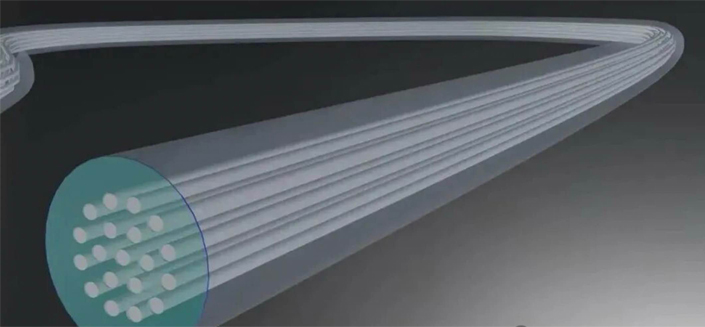
Data shows that in February 2026, my country exported 3,779.9 tons of optical fiber, valued at 790 million yuan, representing year-on-year increases of 63.6% and 126.8%, respectively. Based on an export weight of 0.6667 million core-kilometers per ton, February's exports totaled approximately 25.2 million core-kilometers, with a price of approximately 31.35 yuan per core-kilometer. Exported optical fiber accounted for 65% of domestic monthly effective production. The latest assessment from institutions suggests that currently, approximately 80% or even higher of domestic monthly optical fiber production is exported, with the export share approaching 80%.
The core driver of this surge in demand is the wave of computing power infrastructure construction brought about by AI data centers. According to CRU data, global demand for fiber optic cables for data centers increased by 75.9% year-on-year in 2025. AI computing clusters with tens of thousands of GPU cards require 5 to 10 times more fiber optic cables than traditional data centers. Overseas cloud vendors in North America and other regions have locked up their production capacity and signed large long-term orders, driving the demand for fiber optic cables from traditional communication construction to core computing scenarios.
On the supply side, the high technical barriers and long expansion cycles of upstream optical fiber preforms have become a rigid constraint on short-term supply. This, coupled with a concentrated release of demand, has led to a simultaneous increase in both volume and price globally. As of March 2026, the domestic spot price of G.652.D bare optical fiber reached 83.4 yuan/core-kilometer, a cumulative increase of over 400% since May 2025; similar products in the European market saw a year-on-year increase of 159%, and the price increase trend has spread globally. Institutions predict that the global supply-demand gap may widen to 15% in 2026-2027.
Industry analysts believe that with the long-term trend of AI and computing networks, optical fiber has become a key foundation for the global digital economy. China's optical fiber industry, with its complete industrial chain and production capacity advantages, continues to increase its voice in the global market. In the future, the industry will be deeply integrated with the computing power industry and usher in a more resilient growth cycle.

 English
  日本語
日本語  Deutsch
  italiano
  العربية
  Polska
  Ελλάδα
  română
  slovenský
  Suomi
Suomi  Nederland







 Call us on:
  Email Us:
  Wanhua Science and Technology Park, No. 528, Shunfeng Road, Donghu Street, Linping District, Hangzhou City, Zhejiang Province