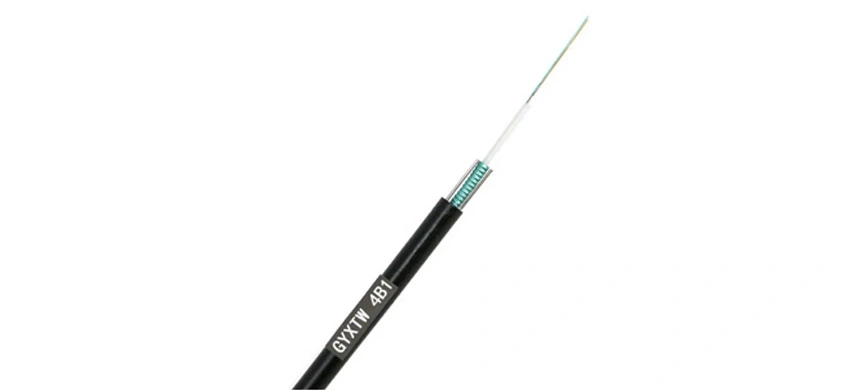
In modern telecommunication networks, smart city projects, and broadband campus expansions, outdoor deployment environments demand absolute mechanical protection and moisture resilience. The GYXTW fiber optic cable by JUNPU is an industry-standard, lightweight, central loose tube outdoor communication cable engineered for aerial, duct, and underground conduit installations.
Designed specifically to maintain signal integrity over varying climate fluctuations, this heavy-duty gyxtw fiber line combines compact structural design with reliable tensile performance to deliver maximum data throughput.
Advanced Armor & Strength Members
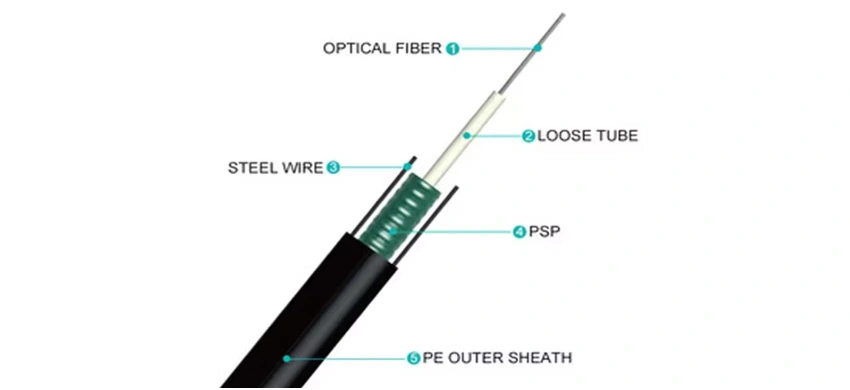
To withstand external crushing forces and lateral stress during pulling, the loose tube is wrapped longitudinally with a layer of corrugated steel tape (PSP). This metallic armor is bonded to the outer high-density polyethylene (HDPE) jacket. Paralleled within this jacket structure are two parallel steel wires (0.8 mm ~ 1.0mm), serving as the heavy-duty strength members to ensure excellent tensile strength and crush resistance.
GYXTW 12 Core: Optimized for localized распределение (distribution) loops, security camera backhauls, and corporate enterprise connections.
GYXTW-24F (24 Core): Designed for high-density telecom trunks, metropolitan area networks (MANs), and industrial FTTH distribution nodes.
Fiber Core Options and International Color-Coding Standards
When sourcing the GYXTW fiber optic cable, selecting the correct fiber mode and understanding the internal structure is vital for seamless splicing. JUNPU provides custom configurations tailored to international telecommunication standards:
Fiber Modes: Available in Singlemode (G.652D, G.657A) for ultra-long-distance, low-attenuation transmission, and Multimode (OM1, OM2, OM3, OM4) for high-bandwidth, short-range campus localized networks.
Standardized Identification: To simplify fiber management during heavy-duty outdoor splicing, the fibers inside our central loose tube utilize the standard TIA/EIA-598 color-coding scheme. For a standard GYXTW 12 core cable, the individual fibers are easily identifiable via 12 distinct, vibrant colors (Blue, Orange, Green, Brown, Slate, White, Red, Black, Yellow, Violet, Rose, Aqua). This strict manufacturing profile eliminates manual positioning errors at the splice tray.
Strict Quality Control and Mechanical Reliability Testing
As a leading gyxtw fiber cable factory, every drum of JUNPU cable undergoes rigorous, ISO-certified mechanical and environmental laboratory testing before leaving our facility to ensure zero-defect deployment in smart city networks:
Tensile Strength Test: Validates that the parallel steel wires maintain standard optical transmission under a maximum short-term pulling force of 1500 N.
Crush Resistance Test: Ensures the corrugated steel tape successfully deflects up to 3000N/100mm of lateral force without rupturing the inner PBT tube.
Water Penetration Evaluation: A 3-meter cable sample is subjected to a 1-meter water column for 24 hours to verify that the internal gel and water-blocking layers completely halt moisture migration.
Temperature Cycling Test: Ensures zero attenuation fluctuations within our standard operating window of -40℃ to +70℃.
 English
  日本語
日本語  Deutsch
  italiano
  العربية
  Polska
  Ελλάδα
  română
  slovenský
  Suomi
Suomi  Nederland






 Call us on:
  Email Us:
  Wanhua Science and Technology Park, No. 528, Shunfeng Road, Donghu Street, Linping District, Hangzhou City, Zhejiang Province