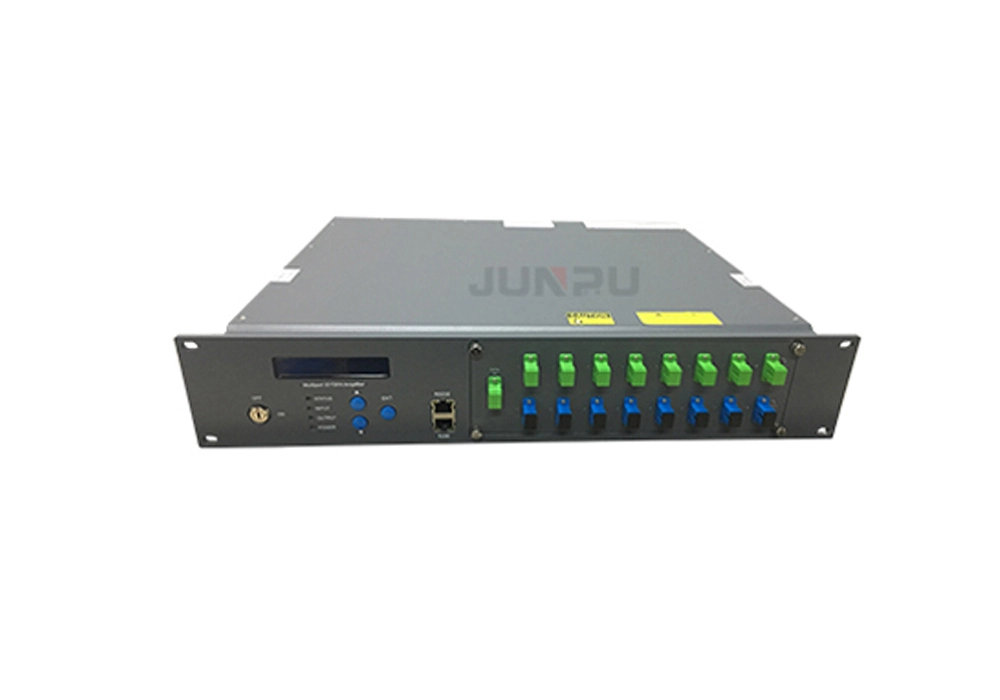
In today's digital age, where efficient and reliable communication is key, the use of optical amplifiers in fiber optic communication systems cannot be ignored. These devices have revolutionized the telecommunications industry by enabling long-distance transmission of signals without the need for frequent signal regeneration. One prominent player in this field is JUNPU, a renowned brand that offers state-of-the-art optical amplifiers.
An optical amplifier is a device that amplifies optical signals directly without converting them into electrical signals. It plays a vital role in extending the reach and capacity of optical fiber communication networks. By boosting the power of optical signals, these amplifiers overcome the challenges of signal degradation and loss that occur during transmission over long distances.
Fiber amplifiers, also known as fiber optic amplifiers, are particularly useful in long-haul communication systems, where signals may travel over thousands of kilometers. They ensure high-quality transmission by compensating for the signal loss experienced in the optical fiber. Furthermore, they eliminate the need for costly and time-consuming signal regeneration stations, leading to significant cost savings in network infrastructure.
When considering the use of optical amplifiers, price is a crucial factor. JUNPU offers competitively priced optical amplifiers without compromising on quality. Their range of products caters to various system requirements, making them a reliable choice for telecommunication companies.
Technical Specifications of JUNPU Optical Amplifiers
To simplify network selection for procurement managers, the table below outlines the core operating benchmarks of JUNPU’s standard high-power multi-port EDFA series:
| Parameter Matrix Components | Standard Telecommunication Profile | Advanced WDM / PON Configurations |
| Primary System Application | Standard CATV Distribution Networks | Multi-Channel gpon edfa / WDM PON Architectures |
| Input Optical Power Range | -10dBm to +10 dBm | -5 dBm to +14 dBm (Optimized) |
| Output Optical Power Stability | ±0.5 dB | Dynamic Power Balancing Auto-Tracking |
| Operating Wavelength Range | 1535nm ~1565 (C-Band) | Dual-Window 1310/1490/1550nm Multiplexing |
| Noise Figure (NF) | ≤5.0 dB (At 0 dBm Input) | Premium Low Noise Profile: ≤4.5 dB |
| Optical Return Loss | ≥45 dB | Built-in Input/Output Isolators |
| Network Management Protocol | SNMP v2 (RJ45 Ethernet Interface) | Full Integration with Central OLT Software |
| Power Supply Requirements | Dual Hot-Swappable 110V/220V AC | -48V DC Industrial Redundancy Options |
Technical FAQ: Optical Amplifiers in Optical Fiber Communication
What is the main purpose of an amplifier in optical fiber communication?
The primary purpose of an amplifier in optical fiber communication is to directly restore the optical power of a degraded signal without decoding or modifying the payload. As light pulses travel down a fiber line, glass attenuation reduces their intensity. High-gain modules like a catv edfa directly inject external pump laser energy into the fiber core, exciting the optical carriers and allowing the signal to travel longer distances before requiring traditional electronic translation.
Why is a WDM PON EDFA critical for modern triple-play fiber networks?
A wdm pon edfa is critical because it acts as the central multi-wavelength combiner and power booster for high-density FTTH (Fiber to the Home) projects. It allows network engineers to overlay high-power 1550nm video feeds from a 1550nm optical transmitter with standard 1310nm upstream and 1490nm downstream GPON data channels. This enables providers to deliver voice, ultra-speed internet, and cable television over a singular physical fiber, maximizing ROI on existing infrastructure.
How does JUNPU keep its optical amplifier prices competitive without losing quality?
When considering the deployment of advanced network hardware, wholesale price is always a crucial deciding factor. JUNPU offers highly competitive pricing structures because we maintain complete, in-house vertical manufacturing lines for our optoelectronic equipment. By optimizing our internal supply chain for laser diodes, optical couplers, and premium optical communication components, we pass the direct factory-level savings onto telecommunication companies and global infrastructure procurement offices worldwide.
What other components are required to complete a high-power CATV fiber network loop?
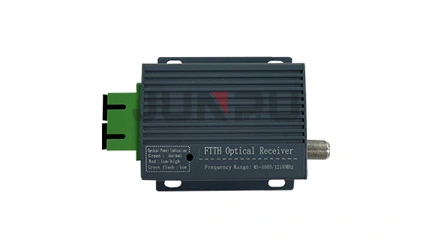
An optical amplifier must always function within an optimized component network. To ensure balanced distribution, a high-power EDFA output is typically split using a premium optical splitter. At the subscriber endpoint or residential distribution hub, the light stream must be converted back into an RF electrical signal using a high-sensitivity optical node or a compact, cost-efficient passive optical receiver. For detailed multi-channel network architectural design and wholesale pricing tiers, please contact the JUNPU optoelectronic engineering division today.
In conclusion, optical amplifiers have revolutionized fiber optic communication systems by enabling long-distance transmission without signal degradation. JUNPU, a brand synonymous with quality and affordability, offers a wide range of optical amplifiers that cater to the diverse needs of the telecommunications industry. With their competitive pricing, JUNPU remains a preferred choice for optical amplifiers in the market.

 English
  日本語
日本語  Deutsch
  italiano
  العربية
  Polska
  Ελλάδα
  română
  slovenský
  Suomi
Suomi  Nederland







 Call us on:
  Email Us:
  Wanhua Science and Technology Park, No. 528, Shunfeng Road, Donghu Street, Linping District, Hangzhou City, Zhejiang Province