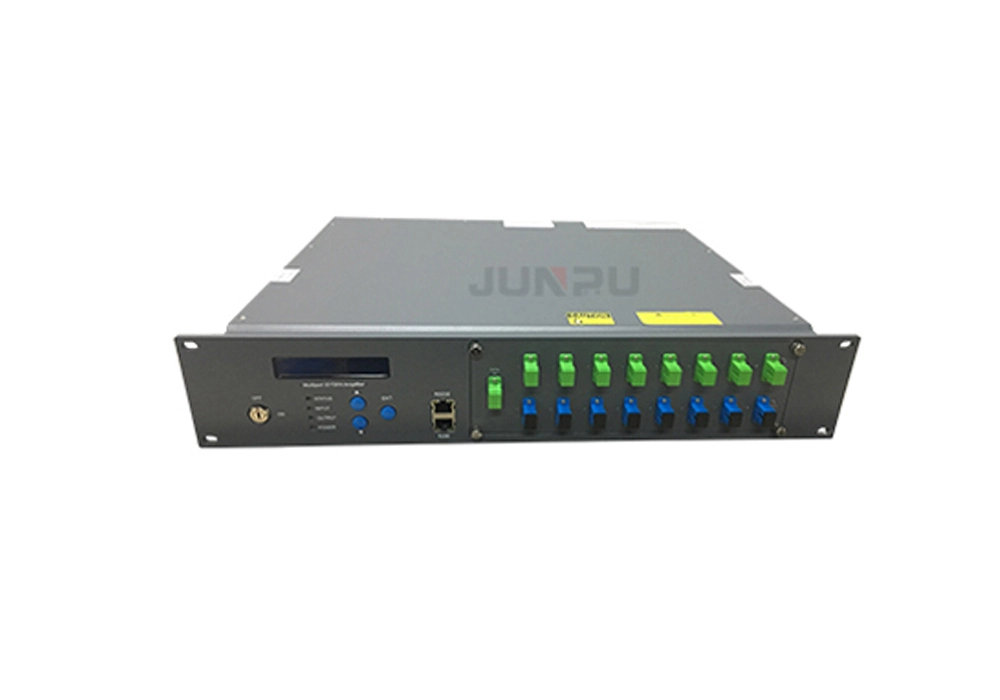
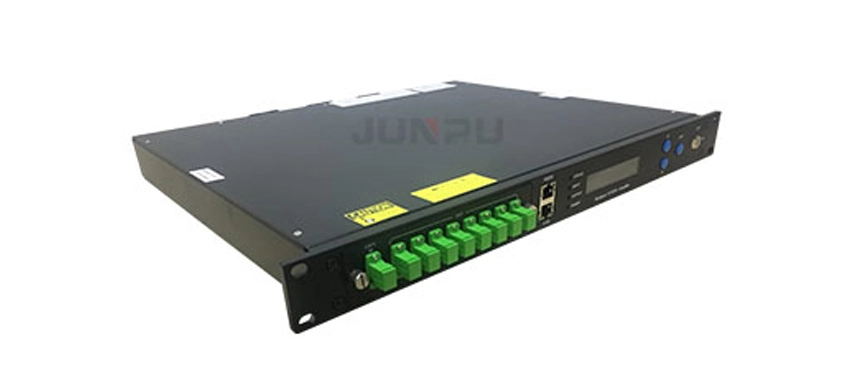
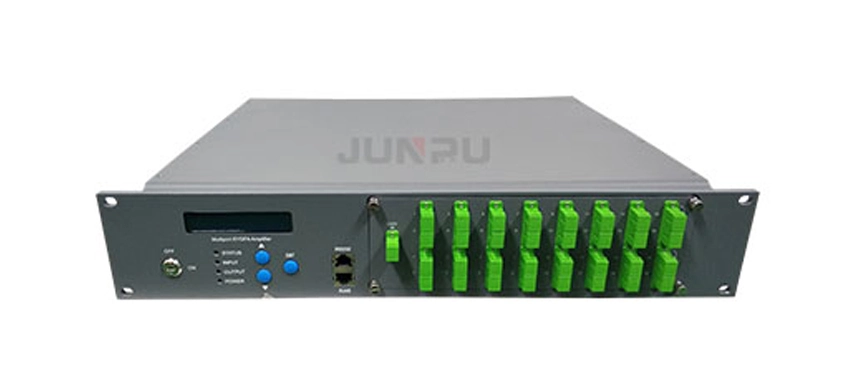
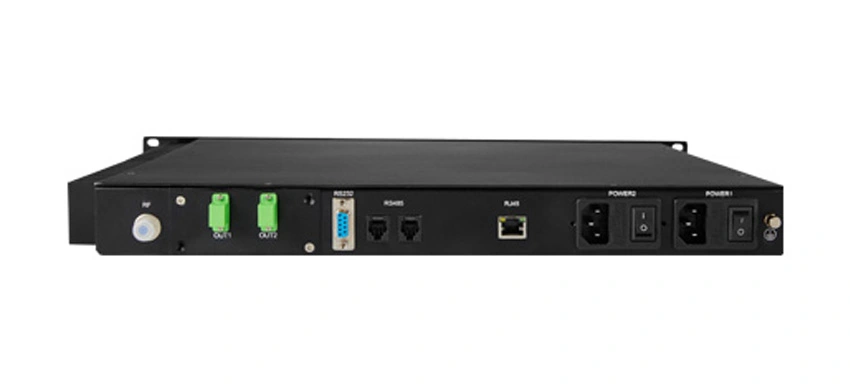
The JP0816EA(1RU) series is a high-power multi-ports optical amplifier designed for EDFA CATV applications. It operates within the gain spectrum band of 1540~1563nm, providing a flexible and cost-effective solution for large-scale CATV coverage in metropolises and medium-sized cities. This amplifier utilizes top-class pump laser and active optical fiber, ensuring long-term and reliable operation. With low noise figure and twin-stage amplification, it offers high-quality signal amplification even at low input power. The front-panel LCD displays equipment status and alerts, while the automatic power-off feature ensures laser security. With options for optical input and network management, it is an ideal choice for system integrators and operators prioritizing reliability and cost-effectiveness. For detailed information such as the specific EDFA price, you can contact us.
Key Components of the EDFA
1. Erbium-Doped Fiber (EDF):
The heart of an EDFA is the erbium-doped fiber, which contains erbium ions (Er3+) incorporated into the silica glass matrix. When optical signals pass through this doped fiber, the erbium ions are excited and emit photons, effectively amplifying the signal. The EDF is the amplification medium in the EDFA.
2. Pump Laser Diodes:
Pump laser diodes are used to excite the erbium ions within the EDF. They emit high-energy photons at a specific wavelength (usually around 980 nm or 1480 nm) that match the absorption bands of erbium ions. These photons are used to "pump" or energize the erbium ions to higher energy levels.
3. Wavelength Division Multiplexer (WDM):
A WDM component is used to combine the input signal (the signal to be amplified) and the pump laser diode signals into the erbium-doped fiber. It ensures that the pump light is efficiently coupled into the EDF to excite the erbium ions.
4. Isolators and Optical Filters:
Isolators and optical filters are used to prevent back reflections and to separate amplified signals from input and output signals. They ensure that amplified light travels in one direction within the EDFA and that the signal-to-noise ratio remains high.
5. Optical Couplers and Connectors:
Optical couplers and connectors are used to couple the input and output fibers to the EDFA. Input signals are fed into the EDF, and the amplified output signals are extracted from the EDFA through these components.
Applications of EDFAs in Long-Haul Optical Networks
Erbium-Doped Fiber Amplifiers (EDFAs) are vital components in long-haul optical networks, enhancing signal strength over extended distances. Here are four key applications:
1. Signal Regeneration: EDFAs boost optical signals, compensating for signal loss in long-distance transmission.
2. Wavelength Division Multiplexing (WDM): EDFAs amplify multiple wavelengths simultaneously, enabling efficient data transmission in WDM systems.
3. Submarine Cable Systems: EDFAs amplify signals across undersea fiber optic cables, facilitating global data connectivity.
4. Telecommunications Backbone: They serve as signal repeaters in terrestrial optical backbone networks, ensuring data integrity over vast distances.
Integrated EDFA + WDM Solutions: Simplifying FTTH Deployment
To meet the increasing demands of Triple-play services (Video, Data, and Voice), JUNPU offers advanced EDFAs with built-in WDM (Wavelength Division Multiplexers). This integrated solution allows the 1550nm CATV signal to be seamlessly combined with 1310nm/1490nm data signals (from OLT) within a single 1RU rack unit, delivering a high-power optical signal directly to the user’s home.
Simplified Network Architecture: By integrating WDM filters inside the amplifier, we eliminate the need for external optical couplers and complex patch cabling. This significantly reduces the space required in your headend rack and simplifies maintenance.
Superior Signal Integrity (Lower Insertion Loss): Our factory-integrated design ensures much lower insertion loss compared to manual external connections. This maintains the highest possible Signal-to-Noise Ratio (CNR), ensuring crystal-clear video quality even at the end of long fiber runs.
Fully Compatible with GPON/XGS-PON: JUNPU’s EDFA+WDM series is purpose-built for modern fiber-to-the-home networks. It provides a perfect video overlay solution, allowing operators to deliver high-bandwidth internet alongside traditional cable TV services over a single fiber strand.
Why Choose JUNPU Multi-Ports EDFA for Your CATV Network?
High Output Power & 16 Ports: Maximize coverage and reduce the number of amplifiers needed per hub.
Low Noise Figure & Twin-Stage Design: Ensure high signal quality (CNR/CSO) even with long feeder fibers.
Designed for CATV: Optimized for the 1540-1563nm band, perfect for analog and digital video transmission.
Front-Panel Monitoring & Alarms: Real-time status display and alerts for proactive network maintenance.
Cost-Effective Solution: Achieve large-scale coverage with a lower total cost of ownership (TCO). When considering the EDFA amplifier price, our products offer a competitive edge in the market.
Reliable & Secure: Top-class pump lasers, automatic power-off, and robust construction for 24/7 operation.
Cost-Efficiency Analysis: Multi-Port EDFA vs. Multiple Single-Port Amplifiers
Why do leading ISP operators prefer the JUNPU JP0816EA series? When scaling your CATV or FTTH network, the choice between a single multi-port unit and multiple standalone amplifiers significantly impacts your bottom line.
| Comparison Factor | Multiple Single-Port EDFAs | JUNPU 16/32-Port Multi-Port EDFA |
| Initial Investment | High (Multiple power supplies, casings, and lasers) | Significantly Lower (Shared components & high-density design) |
| Rack Space (Footprint) | Excessive (Requires 4U-8U for 16 nodes) | Compact (1RU only) |
| Power Consumption | High (Cumulative power draw of multiple units) | Energy Efficient (Optimized single-power module) |
| Cabling Complexity | High (Complex patch cords & external splitters) | Clean & Simple (Integrated splitters/WDM) |
| Failure Points | Many (Multiple fans, lasers, and cords) | Minimized (High-reliability dual-pump lasers) |
| Management | Difficult (Multiple IP addresses to monitor) | Streamlined (Single IP for all ports via SNMP) |
The Bottom Line: By switching to a JUNPU Multi-Port EDFA, operators can typically reduce their total hardware expenditure by 20-35% while saving up to 70% in rack space and operational energy costs.

 English
  日本語
日本語  Deutsch
  italiano
  العربية
  Polska
  Ελλάδα
  română
  slovenský
  Suomi
Suomi  Nederland






 Call us on:
  Email Us:
  Wanhua Science and Technology Park, No. 528, Shunfeng Road, Donghu Street, Linping District, Hangzhou City, Zhejiang Province