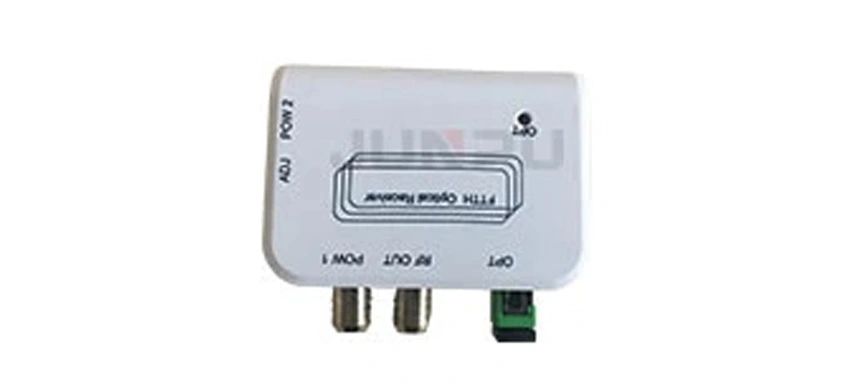
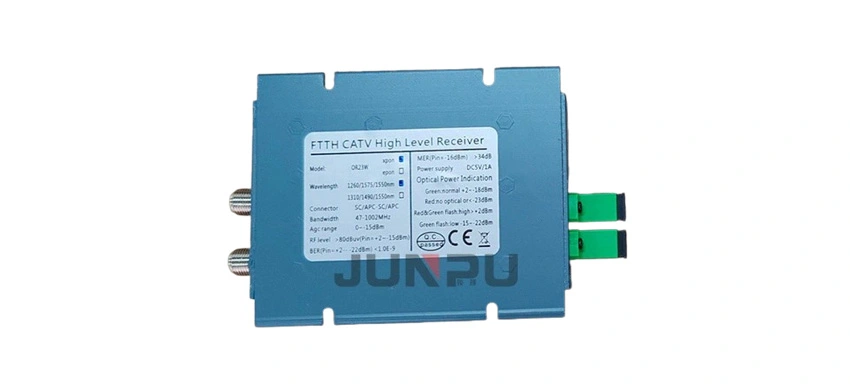
The Mini Optical Node is a small and powerful fiber optic communication equipment used in cable TV systems to receive and distribute optical signals. This versatile optical mini node acts as a critical interface, receiving and distributing optical signals with exceptional reliability. Its small form factor makes the FTTH mini node ideal for space-constrained installations in FTTH (Fiber to the Home), CATV (Cable Television), and RFOG (Radio Frequency over Glass) applications. Engineered for ease of installation and maintenance, Junpu's WDM passive mini node ensures optimal signal quality and efficient distribution to multiple subscribers, supporting both analog and digital signals.
Comparison of JUNPU Mini Optical Node Series
| Model Type | Power Supply | WDM Integration | Input Range (dBm) | Output Level (dBμV) | Best For |
| JP10RW (Passive) | No Power Needed | Yes (Optional) | -15 to 0 | ≥ 60 | FTTH (Direct to Home) |
| JPX86RF (Active) | DC 12V / 5V | No | -10 to +2 | ≥ 80 (with AGC) | FTTB / Small Building |
| Passive Triplexer | No Power Needed | Built-in 1310/1490 | -18 to -2 | ≥ 62 | XGS-PON / Triple Play |
Features of Mini Optical Node
Compact Design: The WDM passive mini node features a compact and space-efficient design, making it suitable for installations with limited space.
Wide Frequency Range: Mini optical node supports a wide frequency range, ensuring compatibility with various signal types and transmission standards.
Optical Input: The Mini optical node is equipped with optical input capability, allowing it to receive optical signals efficiently.
Amplification: Provides signal amplification to compensate for signal loss in the distribution network, ensuring strong and reliable signals to end-users.
RF Output: Delivers high-quality RF (Radio Frequency) output, enabling the distribution of signals to multiple end-users.
High Signal-to-Noise Ratio (SNR): Ensures a high SNR, resulting in improved signal quality and reduced interference.
Advantages of Optical Mini Node
Application Scenarios of Mini Optical Node:
Fiber to the Home (FTTH) Mini Optical Node Networks
FTTH Mini Optical Nodes play a crucial role in FTTH networks, where they are employed to distribute optical signals and ensure reliable connectivity to homes.
Cable Television (CATV) Networks
In cable television systems, Optical Mini Nodes play a crucial role in receiving, amplifying, and distributing optical signals, contributing to the delivery of high-quality TV signals to end-users.
Broadband Internet Networks
Mini Optical Nodes are essential components in broadband internet networks, facilitating the efficient transmission of high-speed data over optical fiber infrastructure.
Hybrid Fiber-Coaxial (HFC) Networks
In HFC networks, which combine both fiber and coaxial cable infrastructure, Optical Mini Nodes are instrumental in converting optical signals to RF signals for distribution over the coaxial portion of the network.
Campus Networks
Educational institutions and large campuses can benefit from the deployment of Mini Optical Nodes to establish high-speed and robust optical communication networks for data, voice, and video services.







 Call us on:
  Email Us:
  Wanhua Science and Technology Park, No. 528, Shunfeng Road, Donghu Street, Linping District, Hangzhou City, Zhejiang Province